3CX AI agents: your calls handled day and night, your teams stay in control
Receptionist, personal assistant, customer service: what 3CX AI agents do, their limits, the FADP and how to get started with MLS.

An unanswered call is often a customer who calls someone else. With the AI agents built into 3CX, a voice assistant picks up, understands the request in the caller's own words, provides information and transfers the call to the right person when needed. We look at what these agents can do, what calls for a genuine integration project, and how we implement them for our clients.
An AI agent in practice
A voice AI agent is software that understands a spoken request and responds in a dialogue. Depending on its configuration, it answers questions, collects information, transfers the call and, if connected to the right systems, carries out authorised tasks.
The difference from a traditional IVR is clear. An IVR imposes a menu: “press 1, press 2”. With an AI agent, callers explain what they need in their own words. A sentence such as “I need help setting up my new phone” is enough to start: the agent offers useful information or puts the caller through to the relevant team.
In 3CX, AI agents rely on OpenAI to understand requests and formulate their answers. They work around the clock and adapt to the caller's language and tone. The administrator sets the languages, whether callers may switch language during the call, and the greeting message. For a company in French-speaking Switzerland that receives calls in French, German or English, this matters.
All agents run in the same 3CX system. You assign roles, define behaviours and extend usage without adding a separate tool. According to 3CX, the agents are built into the system with no additional paid module. They do, however, require 3CX AI Edition and a configured AI provider, whose usage has its own cost.
Three roles, one platform
The needs of a front desk are not the same as those of senior management or a technical department. 3CX therefore offers specialised agents, each with its own instructions and scope. Several can be used in parallel, for different roles, users or departments.
The AI receptionist
It is the first point of contact. It answers incoming calls, greets callers, understands their request, routes them to the right department and handles routine questions. It also screens out unwanted or irrelevant calls before they reach your teams. It remains available outside business hours, in the evening and at weekends.
The AI personal assistant
It is designed for one person: a member of senior management, a partner, a manager in high demand. It screens calls, checks whether the caller is among the trusted contacts, applies the defined availability rules and only transfers relevant calls. It can take a message and avoid unnecessary interruptions.
The AI customer service agent
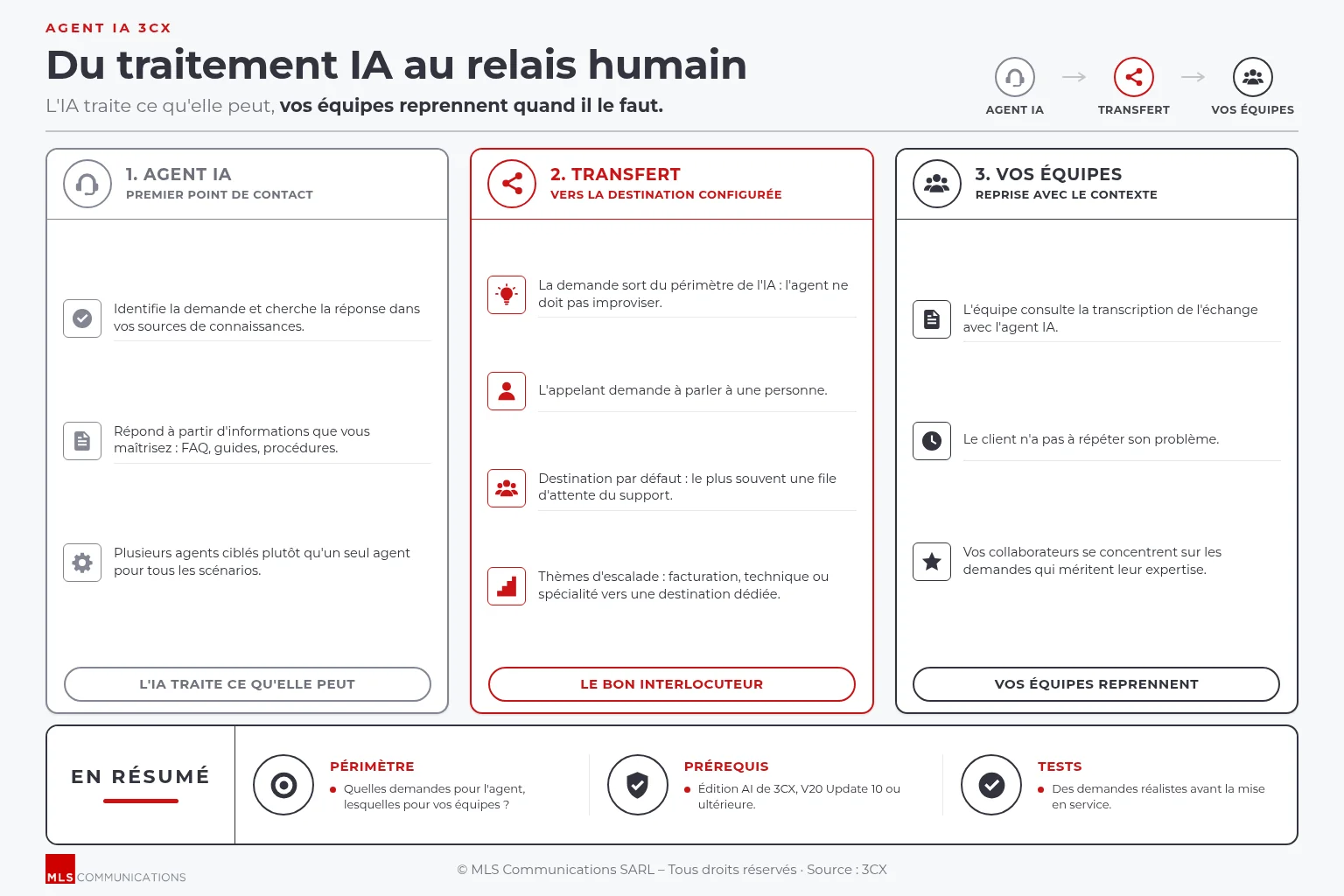
It handles support requests: it answers using the company's validated knowledge, guides customers through common issues and hands over when necessary. For transfers, you configure a default destination to an employee, topic-based escalations to specialised teams, a fallback route if the AI cannot be reached and an availability check before transferring.
Please note: the 3CX product page still lists this agent as “coming soon”, while a 3CX publication from November 2026 describes it as built in and configurable. We check its availability on the installed version before including it in a project.
Answering or acting: knowing the boundary
An AI agent answers using the knowledge sources assigned to it. Checking an order, moving an appointment or updating a customer record is a different matter: it requires access to the relevant business system. A smooth conversation does not prove that a booking has been recorded or that a delivery status is up to date.
For these actions, 3CX offers two options in addition to the built-in agents:
- AI Call Scripts, to build voice scenarios that go beyond the standard configuration;
- Programmable Extensions, which connect an external voice application to 3CX telephony and call control. That application can in turn connect to other business systems.
We therefore treat appointment booking, order lookups and CRM updates as integration projects in their own right. Even when 3CX is already connected to a CRM, you need to check what the agent can actually do. For each action, we define what is authorised, the necessary checks, the confirmation given to the caller and the behaviour if something fails.
What we bring
MLS Communications is a telecom operator specialising in unified communications: Microsoft Teams, 3CX and Centrex. As a 3CX partner and reseller, we deploy, configure and operate the solution for SMEs, professional practices, customer service teams and public authorities. An AI agent is more than a box to tick. Here is how we approach it.
Call scenario analysis
We start from your incoming calls: the most frequent reasons for calling, distribution throughout the day, languages, out-of-hours calls, and current routing via queues, ring groups or IVR. This analysis shows where an agent adds real value and where a person should stay on the front line.
Agent configuration
For each agent, we define its role, instructions, greeting message, languages and hours. A general reception desk and technical support receive distinct instructions and responsibilities.
Knowledge base
The quality of the answers depends on the quality of the content. We help you structure the knowledge base around the questions your customers actually ask, remove outdated documents and eliminate contradictory instructions. Each topic has a designated owner. A good entry contains the answer, any conditions and the next step if the standard answer does not fit. Content is reviewed whenever a product, rule or opening hours change, cantonal public holidays included.
Transfer rules to your teams
A customer must always be able to reach a person when automation is not enough. We define who takes over complaints, how emergencies are handled and what happens outside business hours: transfer, voicemail or callback. We also check what the employee taking over the call can see, and we have the request and next step confirmed before the automated part ends.
Real-world testing
Language support has to prove itself with your customers' vocabulary. We test different accents, speaking rates and background noise, as well as proper names, email addresses, reference numbers and corrections mid-sentence. In Switzerland, this includes place names, numbers in Swiss format, foreign dialling codes and ambiguous dates. We check both the answer given and the action performed.
Operations and monitoring
After go-live, we monitor results, fine-tune the instructions and knowledge base, and keep pace with 3CX updates as part of our support services. Your system can be operated in your own infrastructure or hosted by us in colocation at nLighten in Meyrin, in the canton of Geneva.
Data and security
3CX AI agents work with OpenAI. According to 3CX, all communications between 3CX and OpenAI are encrypted, and the administrator keeps control over access and usage. The prerequisites are 3CX AI Edition and a supported, correctly configured AI provider. The choice of AI model affects response speed, the agent's capabilities and costs.
Hosting the phone system in Switzerland does not change one essential point: speech processing and answer generation go through the AI provider. Under the Federal Act on Data Protection (FADP), several points should be examined before go-live:
- informing callers: telling them that they are talking to an AI and which data is processed;
- disclosure of data abroad: where the AI provider processes the data and the applicable safeguards;
- processing on behalf: contractual commitments with 3CX, the AI provider and, where applicable, the hosting provider;
- data minimisation: collecting only the information needed for the next step;
- sensitive data and professional secrecy, particularly for medical practices, law firms and social services;
- the retention period for recordings, transcripts and messages;
- whether a data protection impact assessment is needed, and updating the record of processing activities.
These are points for review, not legal advice. We provide the technical information on data flows; validation is a matter for your data protection adviser or legal counsel.
Where to start
We recommend starting small, with a simple, measurable use case: a clear question, a reliable answer and a verifiable result.
- Choose a frequent reason for calling: opening hours, site access and addresses, standard questions about a service.
- Or start with collecting information before the transfer: the reason for the call and a confirmed callback number, without asking for anything unnecessary.
- Set the success criterion before launch. For opening hours, the caller gets the exact hours of the right site, public holidays included. For support, the request reaches the right team with the relevant information.
- Measure: tasks completed, callbacks, successful transfers, customer feedback and remaining workload for your employees, broken down by reason for calling and by language.
- Calculate the total cost: licences, AI usage, telecom charges, integration and monitoring.
Once the results show that the agent genuinely helps your customers, you can expand: a second reason for calling, a second agent, then integrations with your business systems.
Frequently asked questions
What is a 3CX AI agent?
A virtual assistant built into 3CX that handles calls, automates communication tasks and can take on different roles within the company: reception, call screening, support.
Which agents are available?
The AI receptionist and the AI personal assistant are available. The customer service agent is listed as “coming soon” on the 3CX product page, but a more recent 3CX publication presents it as built in. We confirm its availability on your version before any project. 3CX states that development in this area is ongoing.
Can several agents be used at the same time?
Yes. Several agents can run in the same system, for different roles, users or departments.
Do AI agents replace staff?
No. They handle routine, repetitive requests. Your employees remain responsible for complex cases, exceptions and service quality.
Do the agents answer 24 hours a day?
Yes, they work continuously, including outside business hours. You need to define what information and next steps are offered when your teams are not available.
Do they speak several languages?
Yes. They understand and respond in several languages and adapt to the caller. The administrator sets the languages and can allow callers to switch language during the call. We recommend testing each language with realistic calls.
What happens if the agent cannot handle a request?
Depending on the configuration, the call is transferred to an employee or routed to voicemail. Destinations and escalation rules are configurable, and we test them both during and outside business hours.
Can an agent book an appointment or check an order?
Yes, provided it is connected to the relevant booking or order system, with appropriate permissions and checks. This is done through AI Call Scripts or Programmable Extensions and is an integration project.
Is communication between 3CX and OpenAI secure?
According to 3CX, all communications between 3CX and OpenAI are encrypted, and the administrator controls access and usage. Data protection questions, including the FADP, still need to be examined case by case (see the “Data and security” section).
Does an AI agent improve productivity?
It can relieve your teams of routine tasks, such as answering frequent questions, collecting information or routing calls, and sometimes more complex tasks once connected to your systems. The real gain is measured on your own calls, which is why it pays to set indicators from the outset.
What savings can be expected?
Automating repetitive requests can reduce certain costs and help absorb call peaks without immediate extra staff. The amount depends on your call volume and reasons for calling. It should be compared with the total cost: licences, AI usage, telecoms, integration and monitoring.
Is an AI agent more accurate and reliable?
It applies its instructions consistently, which reduces certain input errors and oversights. It is not infallible, though: its answers depend on the knowledge base and its configuration. That is why we test both the answer and the action performed, and always provide for a transfer to a person.
Do the agents help with decision-making?
3CX highlights real-time data analysis to identify trends and anticipate problems. In practice, the most immediate benefit lies in tracking the calls handled: reasons, transfers, callbacks. This information helps improve reception and organisation. We treat promises of predictive analytics with caution.
Do the agents personalise the customer experience?
They respond quickly and in a way that fits the request. More advanced personalisation, for example based on the customer's history, requires integration with your systems and a data protection review.
Can several specialised agents work together?
3CX mentions specialised agents working together on complex problems, in healthcare or finance for example. Today, practical use rather consists of dividing roles between agents (reception, personal assistant, support) with clear transfers. Sensitive uses, such as medical diagnosis, are not a matter for a phone agent and remain the responsibility of professionals.
What is needed to use the AI agents?
A 3CX system with AI Edition and a supported, correctly configured AI provider. We check your installation, edition and version before starting.
Review your incoming calls
Wondering whether an AI agent has a place in your phone reception? We offer a demonstration on a scenario close to yours, or an audit of your incoming calls to identify the first use case to automate and the transfer rules to put in place.
Request a demonstration or an audit
Source: 3CX.